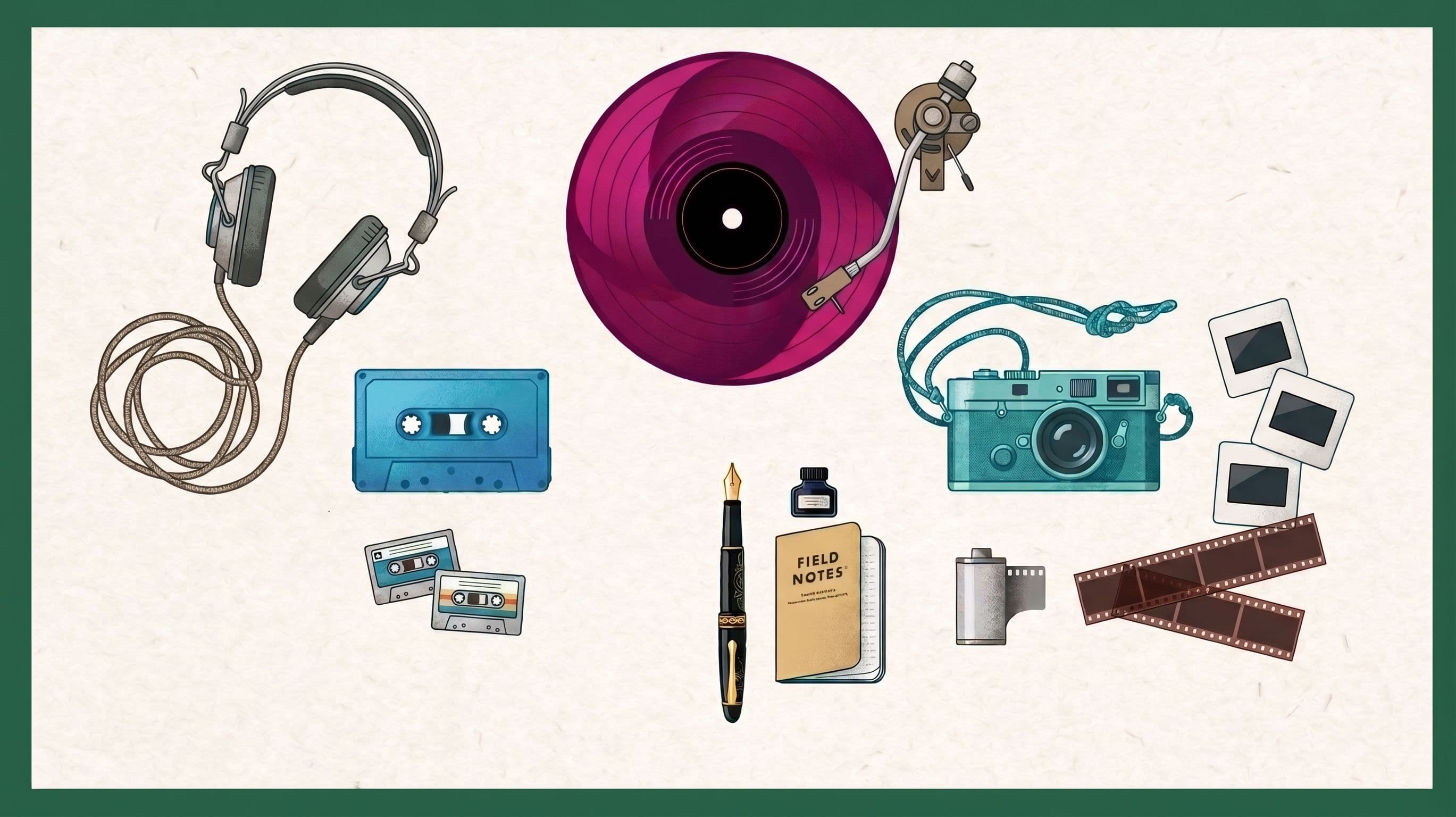
Somewhere between the third short video about "analog bags" and a beautifully filmed clip of someone journaling by candlelight, I caught myself thinking: wasn't the whole point of this to get off the screen?
Welcome to 2026, the year the internet decided being offline is the coolest thing you can do, then wouldn't shut up about it online. And here we are, scrolling through hundreds of posts about how to stop scrolling (I've watched at least twenty of them, so I'm part of the problem).
A 2026 survey commissioned by the bookseller ThriftBooks found that half of respondents have made a point to disconnect and spend less time on screens. People are swapping Spotify for iPods and phone alarms for wind-up clocks. Leather journals are back. Across the feeds, how-to guides, analog-habit explainers, and aspirational montages of everything you could be doing offline rack up views by the thousand, covering photography, music, planning, reading, even how we pack our bags.
But, this is bigger than a wellness fad. Going offline has become a status symbol, and the luxury title LUXUO argues that the ability to switch off now signals power and control. The feeds share the blame. AI-generated content floods every platform, the noise drowns whatever signal was left, and people are tired of wading through it. Almost nobody quits, though. The global user base sits around 5.66 billion and keeps growing. People stay logged in and resent the thing they can't put down. They want out. Or at least they want to want out.
The Irony That Won't Quit
The people shouting loudest about going offline are doing it from the most online places there are.
Take the "analog bag" trend, where users film themselves unpacking bags devoted exclusively to screen-free living and upload the whole ritual. A movement built on putting your phone down has become one of the fastest-growing content categories on the most attention-engineered app ever made. We photograph our film cameras with our iPhones and post handwritten journal pages to our feeds. Someone records themselves reading, lays tasteful lo-fi underneath, hits upload. Every one of these clips has the medium contradicting the message, and nobody minds.
The analog performance only works if it reads as effortless, as a lifestyle you happen to live. The candlelit journal has to look discovered, and staging that discovery takes real work. Hours of it, sometimes, for one post about slowing down.
The Price of Going Simple
Then there's the cost, which is where the movement gets honest about itself. Uff, the cost.
Going old-school is shockingly expensive. A single roll of professional color negative film runs somewhere between $15 and $22 before you've shot a frame, and development and scanning can double the per-roll cost. New cameras from boutique makers arrive at a few hundred euros on the low end and several thousand dollars at the top, while used vintage gear keeps climbing as demand surges. Vinyl that once lived in dollar bins now carries a premium. Add a decent turntable, a proper fountain pen, a real mechanical watch. None of it comes cheap (I priced a turntable recently and quietly closed the tab). To succeed at going analog, you must first go shopping, and at some point the lifestyle revolution starts to look like a shopping list.
Marx's old term for what's inflating the price tags is commodity fetishism. A product does something for you, and then the market wraps it in social meaning (prestige, desirability, cool) and people pay for the meaning. The labor and materials that made the thing get detached from what it's worth in people's heads. The object stops being a tool and becomes a feeling you can buy: belonging, taste, the envy of others, a membership card to a niche.
A $20 film roll sells exactly that feeling. Your phone takes objectively sharper pictures. The roll sells proof that you're the kind of person who shoots film. The expense is the engine of the revival, since scarcity and craft are what make these objects feel precious while infinite, frictionless digital content feels disposable.
Durability pushes the same way. The stuff our parents owned was built to last, and a lot of what we buy now is designed to break or feel outdated fast so we keep replacing it. Analog goods run the other direction. A mechanical watch can be serviced for decades and a turntable can outlive you. A hardcover survives a hundred re-reads. Owning them says you opted out of throwaway culture, and opting out, conveniently, is the membership everyone wants.
Winding film is lovely. So is the crackle of a needle finding its groove, the weight of a real book, the small imperfections of handwriting. All of it, more and more, doubles as an expensive way to signal who you are, and the whole movement runs on that tension.
Who's Actually Driving This?
WGSN's 2026 Future Consumer report points to "gleamers," people chasing small, meaningful joys and community over hustle and tech dominance, as a defining profile. Gen Z treats going analog as defiance laced with romantic yearning for an era they never lived through. Millennials mostly want back the time and attention the digital world quietly swallowed.
The exhaustion is real, but the numbers stay stubborn. The 18-to-24-year-olds most fluent in this aesthetic also spend well over six hours a day on screens. What's new about this wave is how many corners of life the look has reached. Run clubs might be the clearest case. Burned out on swiping, a generation traded dating apps and solo treadmill sessions for showing up in person, and the clubs have more than tripled in a year, with most members joining to meet people rather than to chase a personal best. It looks like the purest form of unplugging. Except the run still gets tracked on an app, the club was found through one, and the meetup goes up on the feed afterward. The booming board game market tells the same story: real tables, dice you can lose under the couch, friends in the room, and a session that still gets documented in real time. The activity is genuine, and the phone never quite leaves the room.
So Is It Real?
So, is any of this real? Are people really logging off? Honestly, not in the numbers. "The year of analog living" is a trend forecaster's phrase. Nobody is throwing their phone into the sea, and the digital world will outlast us all.
Writing the whole thing off as signaling would be too easy, though. As Vogue Adria puts it, going offline reads as a small act of rebellion against a world that was saturated with screens before this generation was old enough to opt in. The college student who wears a wristwatch instead of unlocking her phone forty times a day just wants back something her phone quietly took. Her sincerity is real. The market has an appetite for it anyway. The rebellion that feels honest to the person living it is already getting packaged and priced, then sold back to her. Even opting out becomes a product the system is happy to supply.
So the longing is genuine and the exit mostly goes unused. In 2026, going offline is a feeling people pay real money for, a rejection of the feed staged entirely on the feed, and that contradiction is the movement itself. Disconnection handed the attention economy a new product line and a new genre of post, and the offline life ended up the most online thing we have. We keep posting about how badly we'd like to log off. This post included.